

Background
The hospital plays an essential role in the provision of acute care, specialized medical services and emergency treatments, thus ensuring accessible and high-quality healthcare for the local population.
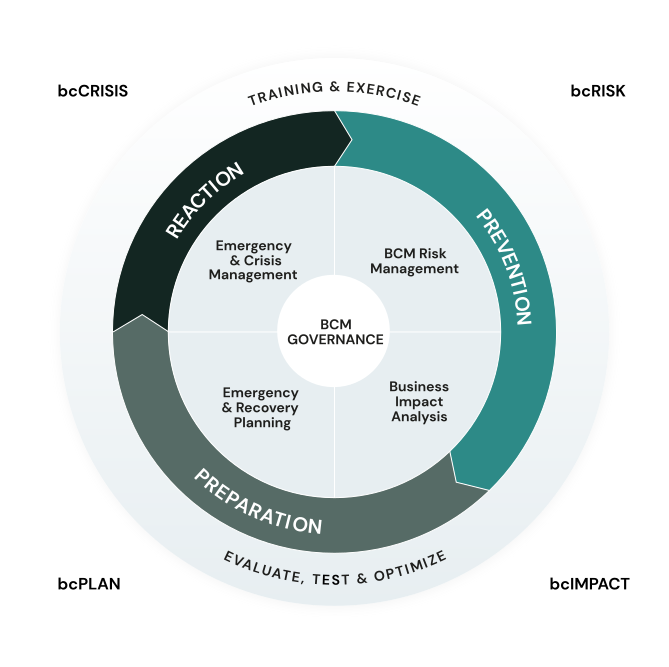
The hospital faced growing exposure to a variety of threats: natural (floods, storms), technical (power outages, fires), intentional (cyberattacks, terrorism), and systemic (pandemics, staff shortages). To ensure the hospital’s ability to maintain critical operations during crises, minimize risks to patient safety, and ensure a rapid return to normal operations, a comprehensive Business Continuity Management System (BCMS) should be established, aligned with ISO 22301:2019 and national critical infrastructure regulations.
Approach
In order to build an effective BCMS, a comprehensive analysis of the hospital’s existing structures and potential vulnerabilities was first carried out. For this purpose, a root cause analysis (BCM Risk Management) and an impact analysis (Business Impact Analysis), specifically tailored to the healthcare sector, were developed, implemented and jointly carried out.
The aim was to identify those areas whose failure would have the greatest impact on hospital operations. Both technical and organizational risks were taken into account and tested by crisis simulations.
Challenges
Cultural diversity and BCM approach
Due to the cultural diversity in Luxembourg, different approaches to BCM as well as to emergency and restart planning have been observed. These differences were reflected in how BCM topics were understood and treated.
RTO requirements in the healthcare sector
In healthcare, recovery time objectives are very short, as any disruption can quickly put patients at risk. Critical services must be restored almost immediately to avoid impacts on life and health.
Risk perception and process awareness
Understanding end-to-end processes
Insights
As a result of the business impact analyses and risk assessments carried out, valuable insights were gained that support the hospital in strengthening its resilience and continuously securing its critical and life-saving healthcare services.
Water supply and sterilization process
Failure of the IT system and patient care
Medication supply and logistics
Power outage and emergency equipment
Communication failure and coordination
Key results
Based on the risk and impact analyses carried out as well as the results from the crisis simulations, targeted measures were developed to strengthen the operational resilience of the hospital. These findings formed the basis for the development of concrete strategies as well as technical and organizational solutions to ensure the continuity of critical hospital functions even under crisis conditions. The implementation of the identified measures led to significant improvements in several key areas of crisis and continuity management. Through the structured structure of its BCMS, the hospital has sustainably improved its organizational and technical resilience.
Ensuring water availability
IT Recovery Planning
Supply chain resilience
Reliable power supply
Backup communication systems
Solution
Further development of the methodology
On the basis of the PoC results, threshold values, weightings and scenario descriptions will be further developed in order to map climate-related changes in a more consistent, comparable and comprehensible way.
Structured roll-out approach
The knowledge gained will be used to define a step-by-step and standardised procedure with which the climate risk analysis can be transferred efficiently and comparably to other motorway maintenance depots.
Centralized tool support
Derivation of future measures