
The “Lëtz Prepare!” initiative is sending a clear signal in Luxembourg. Resilience has long since ceased to be an exclusively state task. Companies, administration, critical facilities, but also numerous organizations beyond formally defined critical infrastructure are responsible for ensuring that central services remain available even under exceptional conditions. Organizations are thus not only potentially affected by crises, but also supporting elements of national resilience in their own right.
Luxembourg’s resilience strategy takes up this idea. It makes it clear that stability and the ability to act in a highly networked society based on the division of labour can only be guaranteed if state provision, economic responsibility and organisational preparation are intertwined. Resilience does not arise in isolation, but in the interaction of public and private actors.
Resilience takes center stage
With “Lëtz Prepare!”, prevention is strategically re-anchored. Preparations for disruptions, emergencies and crises are no longer a marginal discipline, but part of modern governance. Resilience is thus becoming a cross-sectional task for the state, the economy and society.
This approach is contemporary and consistent. Recent years have shown that events rarely occur selectively or in isolation. They unfold their effect along dependencies, interfaces and systemic couplings. A cyberattack on a telecommunications or IT service provider not only affects the directly affected company, but in the worst case can impair the ability of entire social sectors or even a country to communicate and act. The consequences range from restrictions in administration, companies and critical infrastructures to noticeable effects for the population. In extreme cases, safety-relevant functions such as the accessibility of emergency services can be affected.
The same applies to the failure of central digital trust and identity services. If users, companies or administrations can no longer authenticate themselves, complete electronic procedures or use digital services, administrative processes come to a standstill, economic processes are delayed and public services are not available, at least temporarily. What begins operationally as a technical malfunction quickly develops into a systemic crisis with cascading effects.
These correlations make it clear that modern crisis preparedness must not look at risks according to responsibilities or sectors. It must systematically take into account interdependencies, critical paths, bottlenecks and potential single points of failure between the state, the economy, critical infrastructure and the population. This is precisely why the National Resilience Strategy emphasises an integrated, cross-departmental and cross-sectoral approach as a central prerequisite for effective preparedness.
Resilience therefore means more than restoration. At its core, it is about the ability to maintain critical functions even under stress, to make decisions and remain capable of acting, as well as to learn systematically from events.
Prevention is not exclusively a state task
The state creates legal and organizational frameworks, coordinates actors, protects central functions and ensures public safety. At the same time, the state’s ability to control reaches its limits where essential services are provided by private companies, municipal institutions or hybrid forms of organisation. Modern societies function through a dense network of public institutions, private companies, energy and utility companies, IT and cloud providers, financial systems, logistics structures and international supply chains. These systems are highly based on the division of labor, efficiently organized and thus also fragile in parts. Dependencies have often grown historically, are not fully documented and are hardly visible in normal operation.
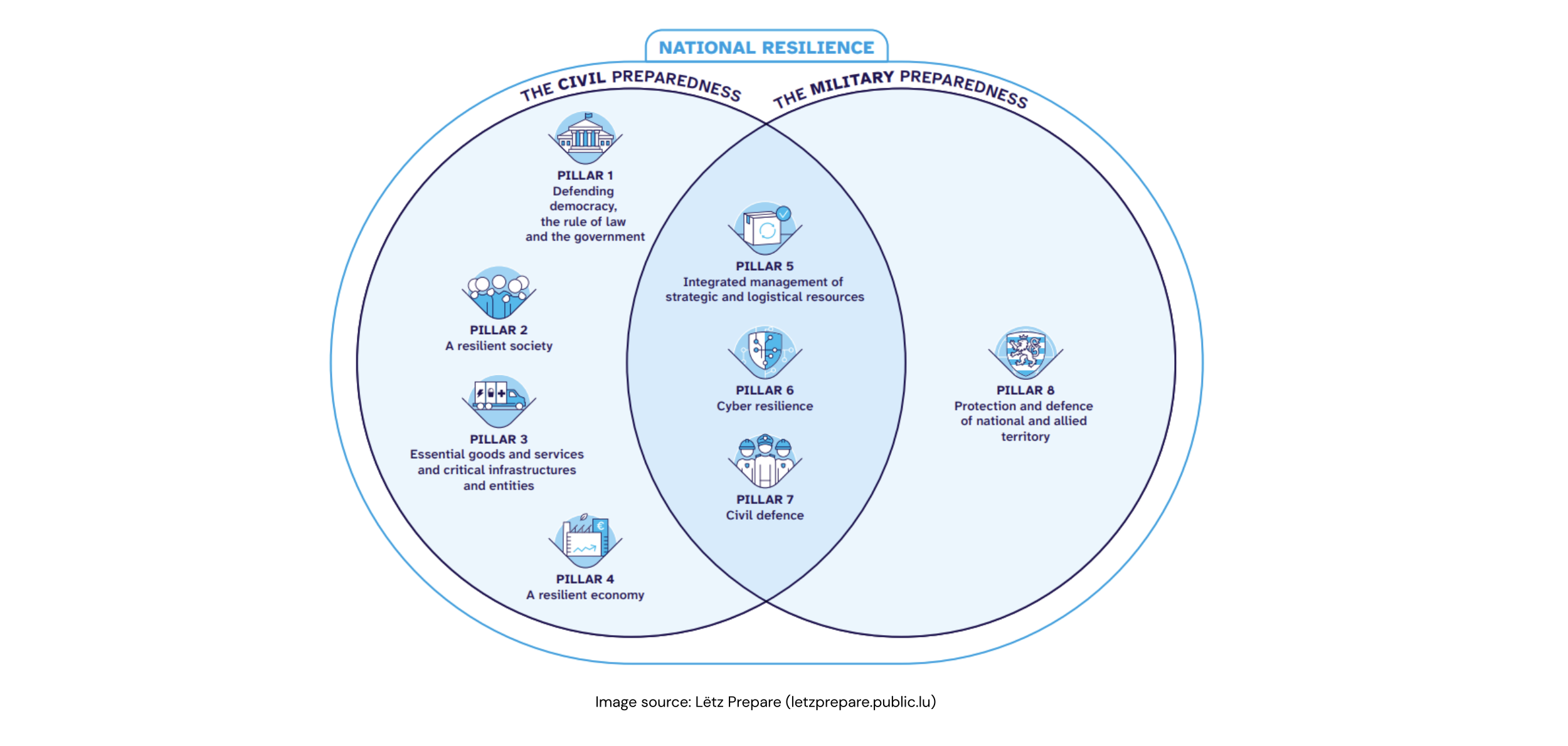
Luxembourg’s resilience strategy addresses this reality. It understands resilience as a task for the whole of the state and society as a whole, which aims to secure the basic functions of the state, the vital interests of the country and the basic needs of the population, even under extraordinary burdens. The strategy combines civilian and military preparation and is based on several substantive pillars. These address, among other things, democratic and social stability, economic performance, security of supply, cyber resilience and the protection of essential goods, services and infrastructures.
A particular focus is placed on protecting vital functions, strengthening public-private cooperation and building a broad culture of preparedness and resilience. Resilience is not created by isolated individual measures, but by coordination, transparency about dependencies and the ability to remain capable of acting even under uncertainty.
For organizations, this results in a clear conclusion. Anyone who provides critical services, is part of relevant value or supply chains, processes sensitive data or performs public tasks is themselves part of the national resilience architecture.
This is not just about formally designated critical infrastructures. Medium-sized companies, IT service providers, logistics companies, municipalities, social agencies, financial service providers, healthcare organizations or specialized industrial suppliers can also develop systemic relevance in the event of a crisis. Therefore, it is not the formal classification of an organization that is decisive, but the effects that a failure of its services would have on other actors, on security of supply and on social stability as a whole.
Organizations as supporting building blocks of societal resilience
This raises the crucial question for organizations as to how the claim of national resilience can be translated into concrete, verifiable precautionary measures. Resilience only becomes effective when it is clear which services must continue to run even under difficult conditions, which dependencies endanger these services and who makes decisions in the event of an incident.
This is exactly where business continuity management, risk management, and emergency and crisis management come in. They translate abstract resilience requirements into concrete organizational capabilities: critical processes and threats are identified, dependencies are analyzed, restart targets are defined, replacement procedures are prepared, measures are established, responsibilities are clarified, and decision-making structures are created for extraordinary events.
The aim is not to predict every conceivable crisis scenario. It is crucial to understand one’s own organization so well that it can prioritize and remain capable of acting even in the event of unexpected events.
Especially in networked organizations, vulnerabilities often lie at interfaces, such as external IT service providers, cloud platforms, logistics partners, specialized suppliers, key people or communication channels that are not available in the event of an incident. In normal operation, such dependencies are often hardly noticeable. In a crisis, however, they can decide whether critical services can be continued or not.
An example makes this clear: If a central procedure fails in an administration, it is not just an IT problem. The decisive factors are which citizen services must continue to be provided, how decisions are documented, which manual replacement procedures exist, how employees are informed and when external bodies are to be involved. Technical restoration very quickly becomes a question of organization, leadership and communication.
Emergency and crisis management consistently complement BCM. While emergency management regulates the immediate response to a specific event, crisis management creates leadership ability in complex, dynamic or reputationally relevant situations. Only when they work together can a resilient pension system be created. Critical services are known, responsibilities have been clarified, communication channels have been prepared, replacement procedures have been described and crisis teams are capable of acting.
For managers, it is crucial to distinguish between formal preparation and actual ability to act. A plan that has never been tested remains an assumption. A restart strategy without coordination with the departments remains theoretical. A crisis team without practice loses valuable time in the event of an incident.
A pragmatic approach lies in a few central questions:
- Which services must continue?
- What dependencies do they endanger?
- Who decides when familiar structures are not available?
- How do you communicate when e-mail, telephony or internal platforms fail?
- When was the last realistic test of the existing emergency, crisis and recovery plans?
Especially in the context of “Lëtz Prepare!”, it becomes clear that organizational resilience arises where strategic precaution is translated into concrete capabilities. Business continuity management, risk management, and emergency and crisis management are not isolated specialist topics, but components of an effective management and pension system.
Impulses beyond Luxembourg
The Luxembourg approach illustrates how national resilience can be anchored in a practical and impact-oriented way. The strength lies not only in the strategic framework, but above all in understanding precautionary measures as a joint task of the state, business, administration and organisations. In this way, “Lëtz Prepare!” also offers a relevant impulse beyond Luxembourg. Not because national structures can be transferred unchanged to other countries, but because the underlying idea is universally valid.
Modern crisis preparedness must start where critical services are actually created, in the interaction of public authorities, private companies, critical institutions, digital service providers, supply chains and specialised organisations.
The decisive factor is not only who is formally responsible, but which functions are essential for the state, the economy and the population, what dependencies support them and what consequences a failure would have for other actors. In this sense, the Luxembourg approach can be understood as a practical orientation framework. It makes it visible that resilience is effective where strategic guidelines, organizational responsibility and practiced ability to act intertwine.
The added value therefore lies not in simply adopting the model, but in the attitude behind it. Resilience arises from clear responsibilities, transparency about dependencies and the willingness to understand prevention as a continuous leadership, coordination and learning task.
Conclusion: Resilience begins before the event
“Lëtz Prepare!” offers an important and practical orientation framework for national precautions. It shows how resilience can be thought of holistically and effectively anchored beyond state structures. However, the actual effectiveness is decided in the organizations themselves, where critical services are consciously defined, dependencies are made transparent, decision-making processes are clarified and pension structures are regularly reviewed and further developed. Resilience is not a state and not a project with an end date. It is a continuous leadership and learning process.
Organizations that understand business continuity management as part of responsible governance not only increase their resilience to unforeseeable events. They create clarity, robustness and trust as well as a sustainable competitive advantage both in day-to-day operations and in exceptional cases. Prevention does not begin with the crisis. It begins with understanding one’s own role within a networked overall system.