
Background
ASFINAG is the operator of the Austrian motorway and expressway network and is responsible for the planning, construction, operation, tolling and maintenance of one of the country’s most important critical infrastructures.
Climate change is increasingly presenting ASFINAG with new challenges in the operation and maintenance of its transport infrastructure. In order to be able to systematically assess the expected change in climate-related risks over the next 75 years, ASFINAG initiated a proof-of-concept for climate risk analysis together with BC Consulting. The aim was to jointly develop and test a practical methodology that conforms to taxonomy. Existing risk management documents from ASFINAG as well as relevant climate risk reports were taken into account. The developed methodology was then tested and validated in practice together with a selected motorway maintenance department.
Approach
Project initiation and goal definition
Joint clarification of the objectives, scope and requirements for a climate risk analysis, taking into account regulatory, strategic and operational framework conditions.
Development of the methodology
Joint development of a structured climate risk analysis based on existing ASFINAG risk management documents, national climate reports and recognised risk management standards.
Definition of risk scenarios
Implementation Proof-of-Concept
Analysis and validation of results
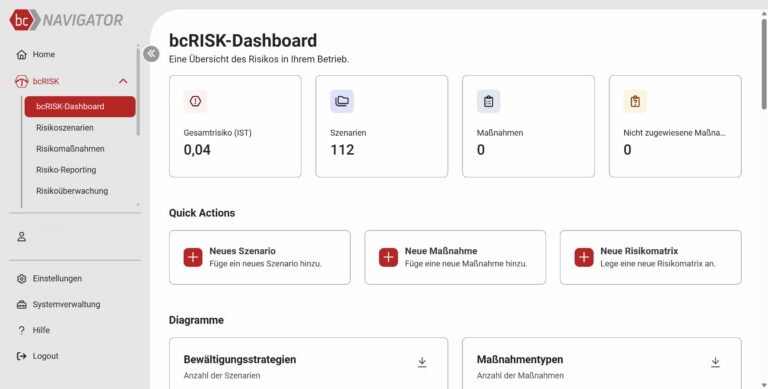
The climate risk analysis was carried out using the bcRISK module in the BCM suite bcNAVIGATOR . bcRISK supported the structured recording of the scenarios, the consistent evaluation over all time horizons, the derivation of current and future measures as well as the transparent evaluation and documentation of the results.


Challenges
A key challenge was to make climate-related risks with a long-term time horizon methodologically tangible and at the same time assessable for operations. In addition, different empirical values, data sources and existing risk logics had to be brought together consistently. Another challenge was that the absolute risk values were low overall, but changed significantly over the periods under consideration and therefore had to be interpreted together.
- Bringing together existing risk management approaches with climate risks
- Assessing long-term risks with limited historical data
- Comparability between different sections of the route
- Dealing with low absolute risk values
- Derivation of sensible future measures
The identified challenges could be addressed through the close joint approach and translated into valuable insights for the further development of the methodology.
Insights
- Uniform scenario descriptions increase the comparability and quality of the assessments across different sections and time periods.
- Currently, the climate risks to infrastructure and its operation are at a low level, but significant increases must be expected over the next few decades.
- The developed methodology enables a consistent assessment of climate-related risks over short-, medium- and long-term time horizons.
- The application of the methodology proved to be practical and easy to understand for the operational unit, even in complex infrastructure and climate contexts.
- The structured presentation of results supports strategic decisions and creates transparency for management and further expansion stages of the analysis.

Solution
Further development of the methodology
On the basis of the PoC results, threshold values, weightings and scenario descriptions will be further developed in order to map climate-related changes in a more consistent, comparable and comprehensible way.
Structured roll-out approach
The knowledge gained will be used to define a step-by-step and standardised procedure with which the climate risk analysis can be transferred efficiently and comparably to other motorway maintenance depots.
Centralized tool support
Derivation of future measures
Conclusion
Expert Process, Project and Crisis Management (PPK), ASFINAG